

Unit 19 — The Middle East
About this unit
The Middle East is one of the most important regions in human history — the birthplace of three world religions and the home of many of the world’s oldest cities. In this unit you will watch a video, look at a map, read about the region, learn about the countries around Israel and their populations and religions, and answer comprehension questions in an interactive practice.
Watch — A Look at the Middle East
Watch this video carefully. You can replay it and turn on subtitles if it helps. After watching, the worksheet at the bottom of the page asks for your reflection.
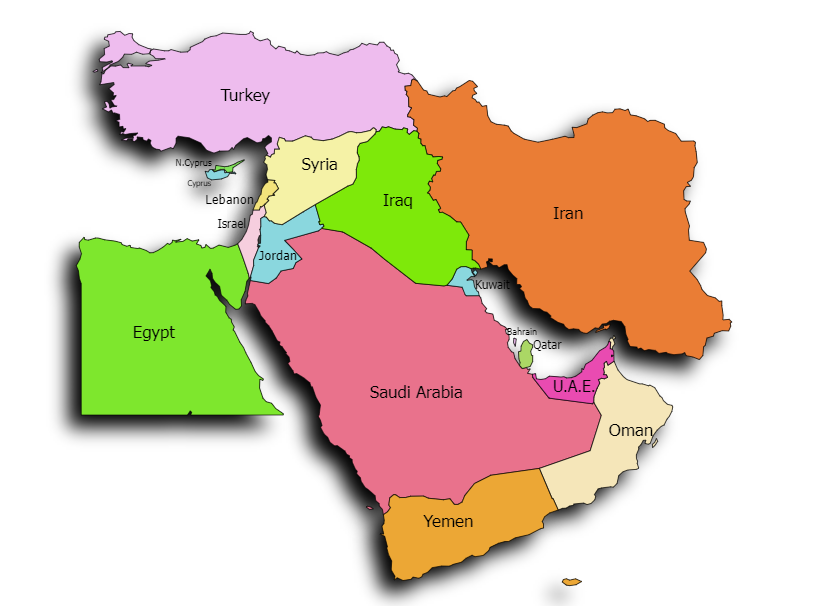
Map of the Middle East
Here is a map of the region. Find Israel in the middle, and try to identify the countries around it: Lebanon, Syria, Jordan, Egypt, and the Palestinian Authority.
Reading: The Heart of the Old World
The Middle East is a region in southwest Asia and northeast Africa. It is one of the most important regions in all of human history. It is the place where humans first built cities, where the first letters and writing were invented, and where some of the most famous events of history have happened.
The Middle East does not have one fixed list of countries, but most experts include: Israel, Lebanon, Syria, Jordan, Egypt, the Palestinian Authority, Saudi Arabia, Iraq, Iran, Turkey, and the smaller Gulf states (the United Arab Emirates, Qatar, Bahrain, Kuwait, Oman) plus Yemen. Together, these countries are home to about 500 million people.
The region’s geography is dominated by big deserts (the Sahara in Egypt, the Arabian Desert in Saudi Arabia, the Negev in Israel), mountains (Mount Lebanon, the Zagros in Iran, the Anti-Lebanon range), important seas (the Mediterranean, the Red Sea, the Persian Gulf, the Dead Sea — the lowest place on Earth) and a few major rivers: the Nile in Egypt, the Jordan between Israel and Jordan, and the Tigris and Euphrates in Iraq.
The Middle East is the birthplace of three of the world’s most important religions:
- Judaism — born about 4,000 years ago in the Land of Israel.
- Christianity — born about 2,000 years ago in the Land of Israel.
- Islam — born about 1,400 years ago in the Arabian Peninsula (today’s Saudi Arabia).
All three of these religions are monotheistic — they believe in one God. They share many of the same stories, prophets, and ideas, but they have grown into very different faiths with their own books, languages, and traditions.
Today, most people in the Middle East are Muslim, but there are also millions of Jews (mainly in Israel) and millions of Christians, especially in Lebanon, Egypt (where Christians are called Copts), Syria, and Iraq. Many smaller religious communities also live in the region — among them the Druze, the Yazidis, the Bahá’í, and the Zoroastrians.
Israel and Its Neighbors
Israel is a small country in the heart of the Middle East. Let’s look at the countries directly around it — their populations, their capitals, and the main religions of their people. (Numbers are approximate; populations change every year.)
Other Important Countries in the Middle East
Beyond Israel’s direct neighbors, here are other key countries in the region:
| Country | Capital | Population | Main Religions |
|---|---|---|---|
| 🇸🇦 Saudi Arabia | Riyadh | ~36 million | Islam (Sunni majority, with a Shia minority) — ~100% |
| 🇮🇶 Iraq | Baghdad | ~45 million | Islam (Shia ~64%, Sunni ~32%), small Christian community |
| 🇮🇷 Iran | Tehran | ~88 million | Islam (Shia ~90%, Sunni ~9%), small Christian, Jewish, Bahá’í, Zoroastrian |
| 🇹🇷 Turkey | Ankara | ~85 million | Islam (mostly Sunni, with Alevi and other minorities) |
| 🇦🇪 United Arab Emirates | Abu Dhabi | ~10 million | Islam ~76%, Christianity ~9%, Hinduism & others (many migrants) |
| 🇾🇪 Yemen | Sana’a / Aden | ~35 million | Islam ~99% (Sunni and Shia) |
| 🇮🇱 Israel | Jerusalem | ~9.8 million | Judaism ~74%, Islam ~18%, Christianity ~2%, Druze ~1.6%, others |
The Three Great Religions of the Middle East
All three are monotheistic religions — they believe in one God.
Vocabulary
| Word | Meaning |
|---|---|
| Middle East | a region in southwest Asia and northeast Africa |
| region | a part of a country, a continent, or the world |
| desert | a place that gets very little rain (e.g. the Sahara, the Negev) |
| mountain | a very high piece of land |
| river | a long line of fresh water that flows across the land |
| sea / gulf | a large area of salt water / a sea partly surrounded by land |
| religion | a system of belief in God or gods, with prayers and traditions |
| monotheistic | believing in one God |
| Judaism | the religion of the Jewish people; sacred book: the Tanakh |
| Christianity | the religion based on Jesus; sacred book: the Bible (Old + New Testament) |
| Islam | the religion based on the Prophet Muhammad; sacred book: the Qur’an |
| Sunni / Shia | the two main branches of Islam |
| Coptic | describing the ancient Christian community of Egypt |
| Druze | a religious community living mainly in Lebanon, Syria, and Israel |
| Arab world | the countries where Arabic is the main language |
| capital | the main city of a country, usually where the government is |
| population | the total number of people living in a place |
| border | the line that separates one country from another |
| peace treaty | an official agreement between countries to stop war and live in peace |
| civil war | a war between groups of people inside the same country |
| prophet | a person believed to bring a message from God |
| sacred | holy or specially important to a religion |
| civilization | a developed society with cities, writing, and government |
Practice — The Middle East
The questions check what you’ve read about the region: its geography, Israel’s neighbors, the three big religions, and key vocabulary. At the end you’ll see your score and can retest only the questions you missed.
After the Lesson — Personal Worksheet
Now think about what you have read and seen. Use this worksheet to write your own answers in your own words. Your answers are saved automatically. When you’re done, you can print your worksheet.
