

Unit 17 — The Continent of Australia
About this unit
This unit takes us “down under” — to Australia, the smallest continent on Earth, and to its neighbour New Zealand and the islands of the Pacific. You will watch a short video, look at a map, read about the geography, history and unique wildlife, learn the key vocabulary, and answer reading comprehension questions in an interactive practice.
Watch — A Look at Australia
Watch this video carefully. You can replay it and turn on subtitles if it helps. After watching, the worksheet at the bottom of the page asks for your reflection.
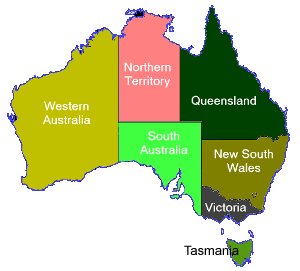
Map of Australia
Here is a map of Australia. Notice how it is one country and one continent at the same time, and how its big cities — Sydney, Melbourne, Brisbane, Perth, and the capital Canberra — are mostly along the coasts.
Reading: Australia — A Country, A Continent, A World of Its Own
Australia is the smallest continent on Earth. It is also unique — it is the only continent that is just one country. About 26 million people live in Australia, and most of them live in cities along the coasts. Together with New Zealand and the smaller island nations of the Pacific (often grouped together as Oceania), it sits in the Southern Hemisphere, far from any other continent.
Australia has the Pacific Ocean to the east and the Indian Ocean to the west. The country is about the same size as the continental United States, but most of the middle is hot, dry, and almost empty — Australians call this region the Outback. Most people live near the coasts, where the climate is milder and the cities are larger. The biggest city is Sydney, but the capital is Canberra — a smaller city that was specially built to be the capital. Other major cities include Melbourne, Brisbane, Perth, and Adelaide.
The geography of Australia is amazing and varied. Off the northeast coast lies the Great Barrier Reef, the largest coral reef in the world — so big it can be seen from space. In the heart of the country stands Uluru (also called Ayers Rock), a huge red sandstone rock that is sacred to Aboriginal peoples. The eastern side of Australia has the long Great Dividing Range mountains, while the south has Mediterranean-like coastlines and good farmland.
The climate of Australia is just as varied. The far north is tropical — hot and wet, with rainforests. The center is desert. The southern coasts have a Mediterranean-like climate, with warm, dry summers and mild, rainy winters. Because Australia is in the Southern Hemisphere, the seasons are reversed compared to Europe and North America: when it is summer in Israel, it is winter in Australia.
The history of Australia is one of the oldest in the world. Aboriginal Australians and Torres Strait Islanders, the indigenous peoples of the continent, have lived there for more than 60,000 years. This makes their culture one of the oldest continuous cultures on the planet. They have hundreds of languages, rich traditions of art, music (with the famous didgeridoo), and a deep connection to the land.
Europeans first explored the eastern coast in 1770, when the British Captain James Cook sailed there. From 1788, Britain began to send settlers and prisoners to Australia, and the continent became a British colony. The arrival of Europeans was very hard for the Aboriginal peoples, who lost much of their land and many lives. In 1901, six British colonies joined together as a single new country — the Federation of Australia. Today, Australia is a free, independent democracy.
The main language of Australia is English, but many Aboriginal languages are still spoken, and people from all over the world have brought their languages too. New Zealand also speaks English, and the country’s indigenous people, the Maori, speak the Maori language. The capital of New Zealand is Wellington; the largest city is Auckland.
Australia is famous for its unique wildlife. Many of its animals — the kangaroo, the koala, the wombat, the Tasmanian devil — are marsupials: mammals that carry their babies in a pouch on their belly. The platypus and the echidna are even stranger — they are mammals that lay eggs. The emu is a tall bird that cannot fly, and the country has many of the world’s most dangerous snakes and spiders.
Modern Australia has a strong economy, based on mining, farming, science, and education. Sydney is famous for its beautiful harbour, its bridge, and the white sails of the Sydney Opera House. New Zealand is famous for its dramatic mountains, sheep farms, and as the location where the Lord of the Rings films were made. The whole region — Australia, New Zealand, and the Pacific islands — is a unique part of the world that anyone who visits remembers forever.
Vocabulary
| Word | Meaning |
|---|---|
| continent | one of the seven very large areas of land on Earth |
| hemisphere | one of the two halves of the Earth (Northern or Southern) |
| Oceania | a region that includes Australia, New Zealand, and the Pacific islands |
| island | a piece of land surrounded by water on all sides |
| coast / coastal | the land next to the sea / next to the sea |
| harbour | an area of sea next to the land where ships can stop safely |
| outback | the dry, remote inland part of Australia |
| desert | a place that gets very little precipitation; can be hot or cold |
| tropical | describing the warm, often rainy areas near the equator |
| coral reef | a large underwater structure made of tiny sea animals (corals) |
| sacred | holy or specially important to a religion or culture |
| indigenous / native | the first people to live in a place, before others arrived from outside |
| Aboriginal | describing the indigenous people of Australia |
| Maori | the indigenous people of New Zealand, and their language |
| colony | a country or area controlled by another country, often from far away |
| federation | a union of states or regions joined under one central government |
| capital | the main city of a country, usually where the government is |
| climate | the usual weather of a place over many years |
| wildlife | wild animals and plants in their natural area |
| marsupial | a mammal that carries its baby in a pouch (e.g. kangaroo, koala) |
| mammal | a warm-blooded animal that feeds its babies milk |
| unique | one of a kind; not like anything else |
| economy | the system of money, work and goods of a country or region |
| remote | far away from cities and other people; isolated |
Practice — Reading Comprehension & Knowledge of Australia
The questions mix reading comprehension (about the passage above) and general knowledge of Australia and Oceania (capitals, landmarks, animals, vocabulary). At the end you’ll see your score and can retest only the questions you missed.
After the Lesson — Personal Worksheet
Now think about everything you have read, watched, and seen in this unit. Use this worksheet to write your own answers in your own words. Your answers are saved automatically. When you’re done, you can print your worksheet.
