

Unit 13 — The Continent of Europe
About this unit
This unit takes us to Europe — the second smallest continent on Earth, but one of the most influential in world history. You will watch a short video, look at a map of Europe, read about its geography, languages and history, learn the key vocabulary, and answer reading comprehension questions in an interactive practice.
Watch — A Look at Europe
Watch this video carefully. You can replay it as many times as you need and turn on subtitles if it helps. After watching, the worksheet at the bottom of the page asks for your reflection.
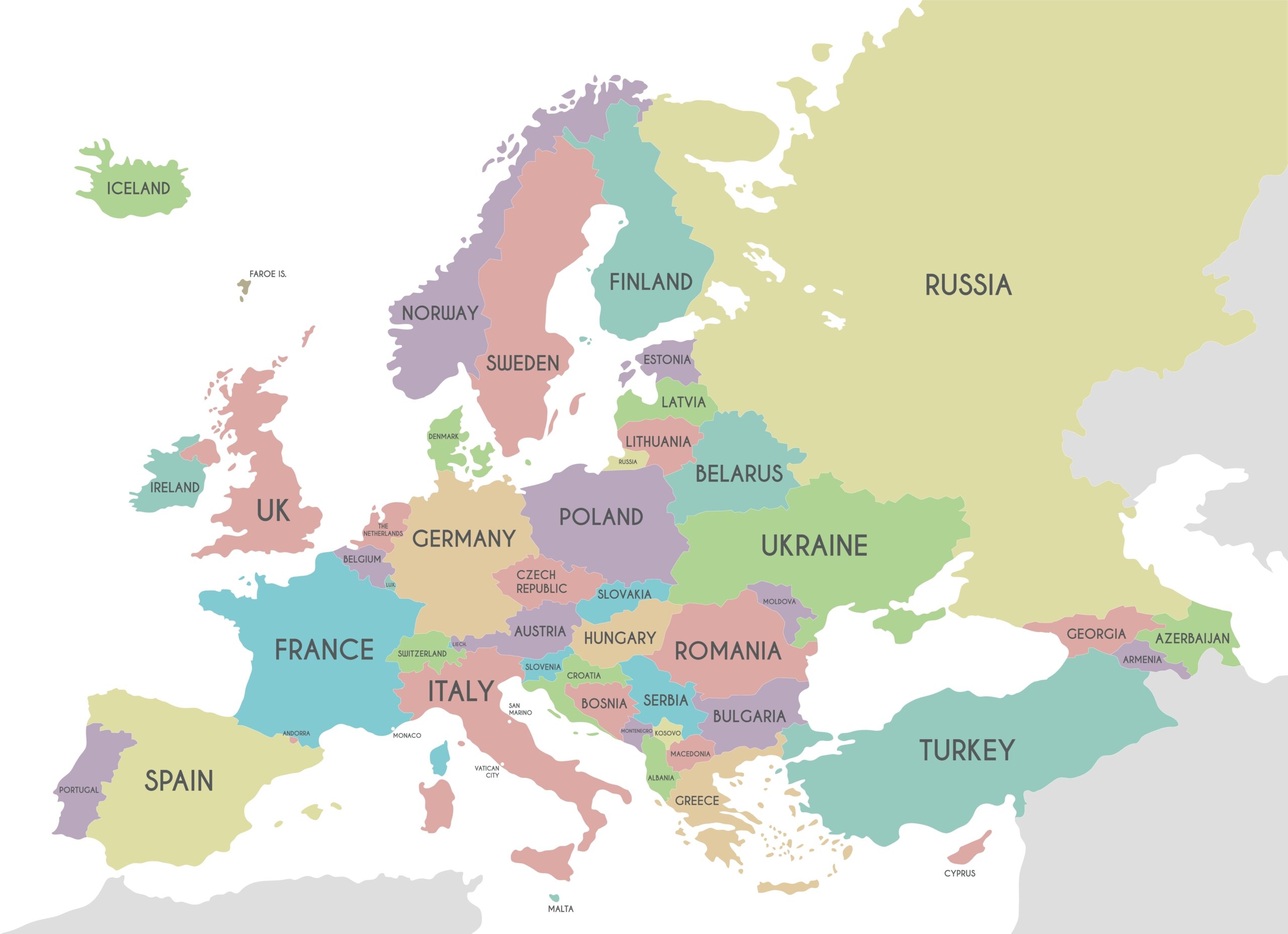
Map of Europe
Here is a map of Europe. Try to find well-known countries — France, Germany, the United Kingdom, Italy, Spain, Greece, Poland, and many more.
Reading: Europe — Small Continent, Big History
Europe is the second smallest continent on Earth — only Australia is smaller. But although Europe is not very big, it is home to about 750 million people, and for hundreds of years it has had a huge effect on the rest of the world.
Most of Europe sits in the Northern Hemisphere. To the west is the Atlantic Ocean; to the south is the Mediterranean Sea and Africa; and to the east is the giant continent of Asia. The line between Europe and Asia is not a sea — it runs along the Ural Mountains in Russia.
Europe has about 50 countries today. Some are very large (Russia, by area, is the largest country in the world and partly in Europe), and some are very small. The most populous countries in Europe are Russia, Germany, the United Kingdom, France, Italy and Spain. Many of the world’s most famous cities — Paris, London, Rome, Berlin, Madrid, Athens — are in Europe.
Europe is famous for its geography. The Alps are a long mountain range that runs through France, Switzerland, Italy, Austria and other countries. Other important mountains include the Pyrenees (between Spain and France) and the Carpathians in eastern Europe. Long rivers — the Danube, the Rhine and the Volga — connect cities and countries across the continent.
People in Europe speak many languages. Most of them belong to a big family called the Indo-European family. Inside this family there are smaller groups: Germanic languages (English, German, Dutch, Swedish), Romance languages (French, Spanish, Italian, Portuguese, Romanian), and Slavic languages (Russian, Polish, Czech, Ukrainian). Greek and a few other languages stand on their own.
The climate of Europe is varied. In the far north (Norway, Sweden, Finland, Iceland) winters are long, dark and very cold. In the south, around the Mediterranean, summers are hot and dry, and winters are mild and rainy — this is called a Mediterranean climate. In the middle of the continent the weather has four clear seasons.
Europe has had an enormous effect on history. The ancient civilizations of Greece and Rome gave the world early ideas about democracy, law, philosophy, and architecture. Centuries later, the Renaissance brought new energy in art and science, and the Industrial Revolution (which began in the United Kingdom in the 1700s and 1800s) changed how people work and live everywhere. The 20th century also began in Europe — and so did the two terrible World Wars of that century.
After 1945, many European countries decided to work together to keep the peace. They created an organization that today is called the European Union (the EU). The EU has 27 member countries. Most of them share a common currency called the Euro, and citizens of EU countries can usually travel and work freely between them.
Today, Europe is one of the world’s centers of education, science, technology, art, fashion, and food. Even though it is small in size, it is still very big in influence.
Vocabulary
| Word | Meaning |
|---|---|
| continent | one of the seven very large areas of land on Earth |
| hemisphere | one of the two halves of the Earth (Northern or Southern) |
| population | the total number of people living in a place |
| influence | the power to change other people, events, or places |
| populous | having a lot of people; with a big population |
| capital | the main city of a country, usually where the government is |
| geography | the study of the lands, mountains, rivers and people of a place |
| mountain range | a long line of mountains close together (e.g. the Alps) |
| river | a long line of fresh water that flows from high land to the sea |
| language | the system of words and rules people use to speak and write |
| language family | a group of related languages with a common origin |
| Romance language | a language that comes from Latin (e.g. French, Spanish, Italian) |
| Germanic language | a language in the Germanic group (e.g. English, German, Dutch) |
| Slavic language | a language in the Slavic group (e.g. Russian, Polish, Czech) |
| climate | the usual weather of a place over many years |
| Mediterranean climate | a climate with hot, dry summers and mild, rainy winters |
| civilization | a developed society with cities, writing, and government |
| democracy | a system of government in which the people choose their leaders |
| Renaissance | a historical period (about 1400–1600) of new ideas in art and science |
| Industrial Revolution | the period when factories and machines began to change work and life (1700s–1800s) |
| European Union (EU) | an organization of 27 European countries that work together economically and politically |
| currency | the money used in a country (e.g. Euro, Dollar, Pound) |
| member (country) | a country that belongs to an organization (like the EU) |
| peace / peaceful | a state without war / calm and without fighting |
Practice — Reading Comprehension & Knowledge of Europe
The questions mix reading comprehension (about the passage above) and general knowledge of Europe (capitals, languages, EU, vocabulary). At the end you’ll see your score and can retest only the questions you missed.
After the Lesson — Personal Worksheet
Now think about everything you have read, watched, and seen in this unit. Use this worksheet to write your own answers in your own words. Your answers are saved automatically. When you’re done, you can print your worksheet.
