

Unit 12 — The Continent of Antarctica
About this unit
This unit takes us to Antarctica — the most extreme continent on Earth. You will watch a short video, look at a map of Antarctica, read about its climate, ice, wildlife, and the international treaty that protects it, and answer reading comprehension questions in an interactive practice.
Watch — A Look at Antarctica
Watch this video carefully. You can replay it as many times as you need and turn on subtitles if it helps. After watching, the worksheet at the bottom of the page asks for your reflection.
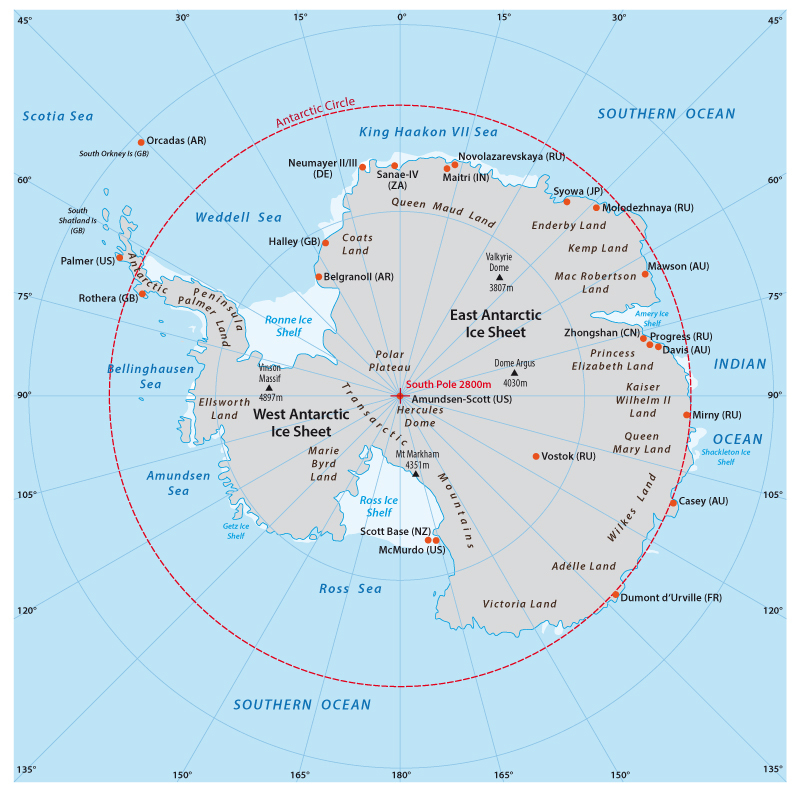
Map of Antarctica
Here is a map of Antarctica. Notice the South Pole in the center, and the surrounding Southern Ocean. The continent is about 1.5 times the size of the United States, but is almost completely covered with ice.
Reading: Antarctica — The Frozen Continent
Antarctica is the most extreme continent on Earth. It sits at the very bottom of our planet, covering the entire South Pole. It is the coldest, the driest, the windiest, and the highest continent — and it is also the only continent without any permanent population. No country owns Antarctica.
The whole continent is covered by a huge ice sheet that is, on average, about 2 kilometers (2,000 meters) thick. This ice holds about 70% of the world’s fresh water. If all of it suddenly melted, the oceans of the world would rise by more than 50 meters — enough to flood most coastal cities.
Temperatures in Antarctica are unbelievably cold. In winter they can fall below -80°C. The coldest temperature ever recorded on Earth was -89.2°C, measured in 1983 at a research station called Vostok. Even in summer, in most of the continent, the temperature stays below 0°C.
Antarctica is also a desert — in fact, it is the largest desert in the world. A desert is not only a place that is hot and sandy. It is any place that gets very little precipitation (rain or snow). Antarctica gets about as much precipitation as the Sahara.
Although no humans live in Antarctica permanently, between 1,000 and 5,000 scientists from many countries live and work there each year, depending on the season. They study the climate, the ice, the wildlife, and the stars. The continent is protected by an international agreement called the Antarctic Treaty, signed in 1959. Under this treaty, Antarctica can only be used for peaceful scientific research — no mining, no military bases, and no nuclear testing.
The wildlife of Antarctica is amazing. Penguins (Emperor, Adelie, Gentoo, and Chinstrap) cover the coasts in huge groups. Seals, whales, and many kinds of sea birds live in or near the cold waters. There are no land mammals, no trees, and no flowers — just ice, rock, and the small plants and animals that can survive at the edge of the continent.
Antarctica is also extremely important for the rest of the world. The continent and its ice help keep our planet’s climate stable. As global temperatures rise, the ice slowly melts — and that affects sea levels and weather patterns far away from the South Pole. For this reason, scientists from many different countries work together in Antarctica to understand what is happening to our planet, and what we can do about it.
Vocabulary
| Word | Meaning |
|---|---|
| continent | one of the seven very large areas of land on Earth |
| South Pole | the most southern point on Earth |
| ice / ice sheet | frozen water / a huge layer of ice that covers a large area |
| thick | having a large distance from one side to the other (the opposite of “thin”) |
| fresh water | water that is not salty (in rivers, lakes, ice — not the sea) |
| melt | to change from a solid (like ice) into a liquid (like water) |
| sea level | the height of the surface of the sea |
| coastal | next to the sea (a coastal city is built next to the sea) |
| temperature | how hot or cold something is, usually measured in degrees |
| record (verb) | to write down or save information so it is not forgotten |
| desert | a place that gets very little rain or snow (it can be hot OR cold) |
| precipitation | rain, snow, or any other water that falls from the sky |
| scientist | a person whose work is to study science |
| research station | a building where scientists live and work to study an area |
| treaty | an official agreement, usually between countries |
| peaceful | without war or fighting; calm |
| wildlife | wild animals and plants living in a natural area |
| penguin | a black-and-white sea bird that cannot fly, common in Antarctica |
| seal / whale | large sea mammals that live in cold ocean water |
| mammal | a warm-blooded animal that feeds its babies milk (e.g. people, whales, dogs) |
| climate | the usual weather of a place over many years |
| climate change | long-term changes in the temperature and weather of our planet |
| stable | steady — not changing very much |
| extreme | far beyond the normal — very, very (cold, hot, fast, etc.) |
| permanent | lasting forever, or for a very long time (the opposite of “temporary”) |
Practice — Reading Comprehension & Knowledge of Antarctica
The questions mix reading comprehension (about the passage above) and general knowledge / vocabulary (penguins, treaty, climate words). At the end you’ll see your score and can retest only the questions you missed.
After the Lesson — Personal Worksheet
Now think about everything you have read, watched, and seen in this unit. Use this worksheet to write your own answers in your own words. Your answers are saved automatically. When you’re done, you can print your worksheet.
