

Unit 11 — The Continent of Asia
About this unit
In this unit we travel to Asia — the biggest and most crowded continent on Earth. You will watch a short video, look at a map of Asia and the flags of its countries, read about its geography, people and history, and answer comprehension questions in an interactive practice.
Watch — A Look at Asia
Watch this video carefully. You can replay it, and you can turn on subtitles if you need to. After you finish watching, the worksheet at the bottom of the page asks for your reflection.
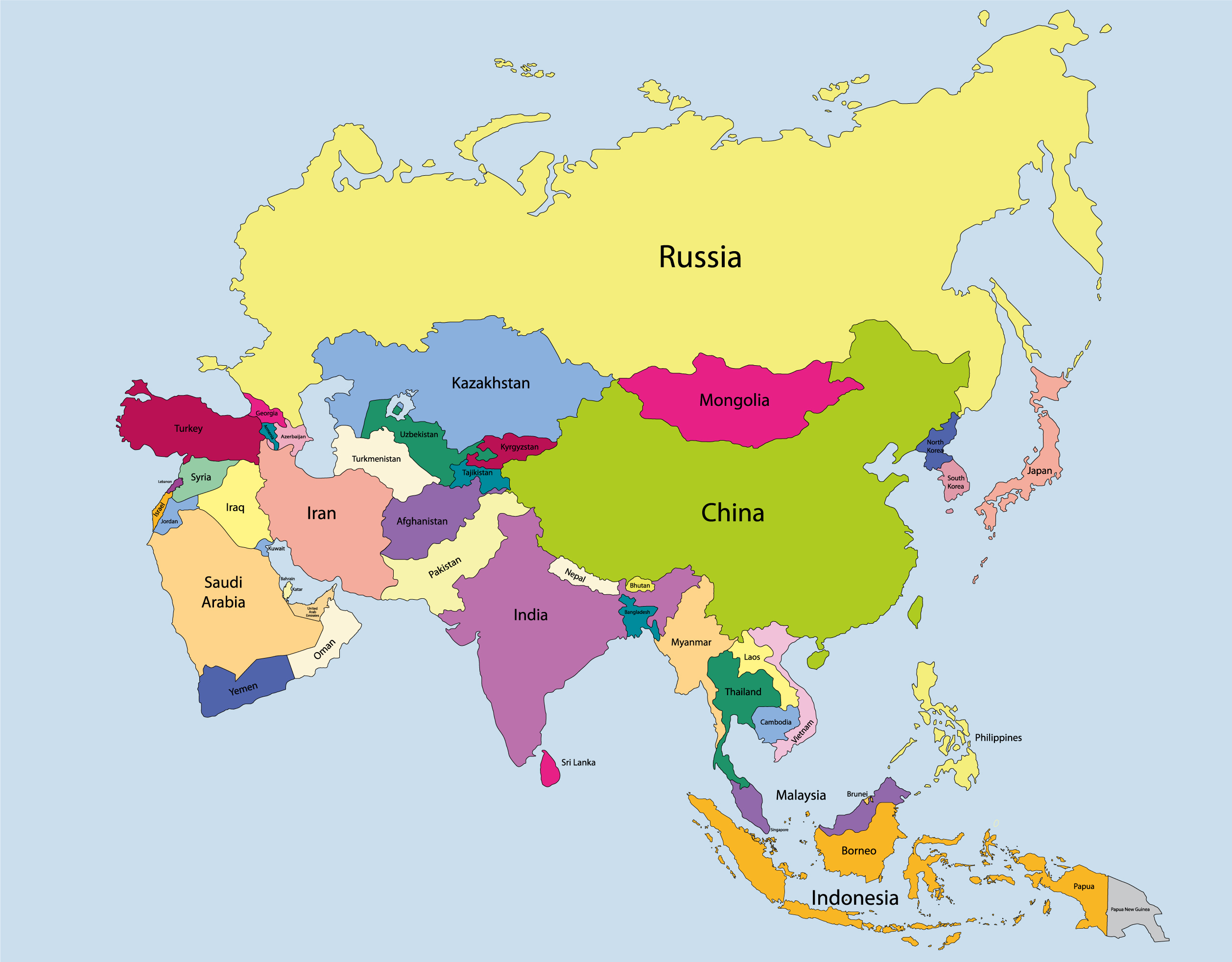
Map of Asia
Here is a map of Asia. Find the countries you have heard of — China, India, Japan, Indonesia, Iran, Saudi Arabia, Israel and many more.
Reading: Asia — The Largest Continent
Asia is the largest continent on Earth, covering about 30% of all the land on the planet. It is also the most crowded — more than 4.7 billion people live in Asia. That is more than the population of every other continent combined.
Asia stretches from the cold Arctic Ocean in the north to the warm equator in the south, and from the Mediterranean Sea in the west all the way to the Pacific Ocean in the east. Because the continent is so big, the geography of Asia changes a lot from place to place. You can find the highest mountains in the world (the Himalayas), huge deserts (the Gobi), endless cold forests (Siberia), tropical jungles (Indonesia, Malaysia), and some of the largest modern cities anywhere — Tokyo, Shanghai, Mumbai, Seoul, Jakarta.
Asia has 48 countries today. Some of the most well-known are China, India, Japan, South Korea, Indonesia, Thailand, Vietnam, the Philippines, Iran, Saudi Arabia and Israel. China and India by themselves are home to more than a third of all the people in the world.
People in Asia speak hundreds of different languages — Mandarin Chinese, Hindi, Arabic, Bengali, Japanese, Korean, Indonesian, Russian, Hebrew, and many more. Several of the world’s biggest religions began in Asia, including Judaism, Christianity, Islam, Hinduism, Buddhism and Sikhism.
The climate of Asia is just as varied as its geography. Siberia, in the north, is one of the coldest places on Earth in winter. Southeast Asia is warm and rainy almost all year. Central Asia has dry deserts and hot summers. The Middle East has long, hot summers and short, mild winters.
Asia is also where many of humanity’s earliest civilizations grew up — in the river valleys of the Tigris and Euphrates (the area called Mesopotamia), the Indus, and the Yellow River in China. These ancient cultures gave the world early forms of writing, mathematics, agriculture, law, and government — ideas we still use today.
In the modern world, Asia is one of the fastest-growing regions on the planet. It is home to some of the largest economies (China, Japan, India), the busiest ports, and many of the world’s leading technology companies. To understand today’s world — its news, its trade, its science, its culture — you almost always need to understand a little about Asia.
Vocabulary
| Word | Meaning |
|---|---|
| continent | one of the seven very large areas of land on Earth |
| population | the total number of people living in a place |
| crowded | full of a lot of people in a small area |
| billion | one thousand million (1,000,000,000) |
| stretch (from … to) | to spread or extend over a wide area |
| geography | the study of the lands, mountains, rivers and people of a place |
| mountain range | a long line of mountains close together (e.g. the Himalayas) |
| desert | a very dry area with little rain (e.g. the Gobi) |
| jungle | a thick, hot forest, usually in tropical places |
| tropical | describing the warm, often rainy areas near the equator |
| modern | of the present time, today’s |
| ancient | very old; from a time long, long ago |
| civilization | a developed society with cities, writing and government |
| river / valley | a long line of fresh water / the low land between two hills or mountains |
| religion | a system of belief in God or gods, with prayers and traditions |
| economy | the system of money, work and goods of a country or region |
| technology | tools, machines and methods that science creates to solve problems |
| climate | the usual weather of a place over many years |
| region | a part of a country, a continent, or the world |
| diverse / diversity | very different and varied; many different kinds together |
| capital | the main city of a country, usually where the government is |
| flag | a piece of cloth with a special design that represents a country |
| coast / coastal | the land next to the sea / next to the sea |
Flags of Asia — Speaking Activity
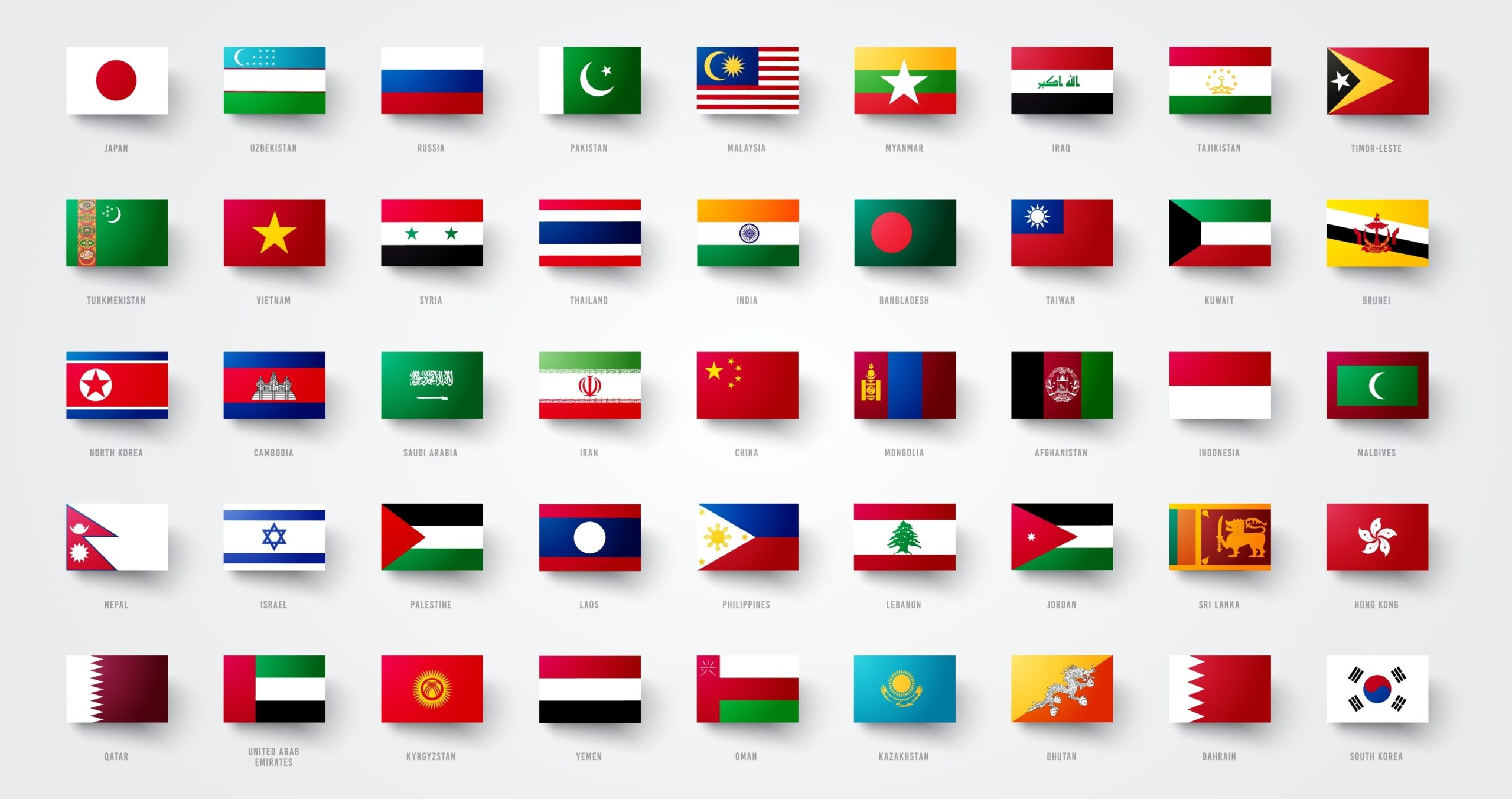
Below are the flags of the countries in Asia. Take some time to look at them. Notice the different colors, symbols, and shapes.
🗣 Speaking Task — A Short Conversation with Your Teacher
Pick three flags from the picture above. With your teacher, have a short conversation in English about each one. Try to use full sentences. For each flag, say:
- The country. "This flag is from ______."
- The colors and shapes you see. "I can see ___ stripes / a ___ star / the colors are ___ and ___."
- One thing you know about the country. "I know that this country is famous for ___ / is in ___ Asia / is very big / is an island / etc."
Useful sentences: "I think this is the flag of ___." · "I’m not sure, but it looks like ___." · "Can you help me with this one?" · "What does this symbol mean?"
Practice — Reading Comprehension & Knowledge of Asia
The questions mix reading comprehension (about the passage above) and general knowledge of Asia (countries, capitals, geography, vocabulary). At the end you’ll see your score and can retest only the questions you missed.
After the Lesson — Personal Worksheet
Now think about everything you have read, watched, and seen in this unit. Use this worksheet to write your own answers in your own words. Your answers are saved automatically. When you’re done, you can print your worksheet.
