

Unit 14 — The Continent of North America
About this unit
This unit takes us to North America — the third largest continent on Earth, and home to one of the world’s most powerful economies. You will watch a short video, look at a map of North America, read about its geography, history, languages, and people, learn the key vocabulary, and answer reading comprehension questions in an interactive practice.
Watch — A Look at North America
Watch this video carefully. You can replay it as many times as you need and turn on subtitles if it helps. After watching, the worksheet at the bottom of the page asks for your reflection.
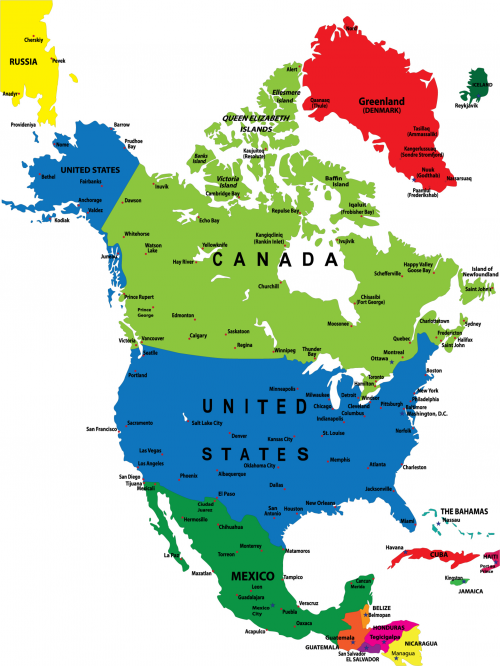
Map of North America
Here is a map of North America. Find the three large countries — Canada, the United States, and Mexico — as well as Central America and the Caribbean islands.
Reading: North America — From the Arctic to the Tropics
North America is the third largest continent on Earth, after Asia and Africa. It stretches all the way from the cold Arctic Ocean in the north to the warm tropical Caribbean Sea in the south. The Pacific Ocean is to the west, and the Atlantic Ocean is to the east. Around 600 million people live on the continent.
North America has three large countries — Canada, the United States of America, and Mexico — plus the seven smaller countries of Central America (such as Guatemala, Costa Rica and Panama) and the many islands of the Caribbean (such as Cuba, Jamaica, and the Dominican Republic). Greenland, the largest island in the world, is also geographically part of North America.
The geography of North America is huge and varied. The Rocky Mountains run down the western side of the continent, from Canada all the way to the southwestern United States. In the middle of the continent are the wide, flat Great Plains, where farmers grow much of the world’s wheat and corn. The Great Lakes — five enormous freshwater lakes on the border between the USA and Canada — are some of the largest lakes in the world. The Mississippi River is the longest river in the United States, and the Grand Canyon in Arizona is one of the most famous natural landmarks on the planet. Another world-famous landmark is Niagara Falls, on the border between the USA and Canada.
The climate of North America is as varied as its geography. The far north (Canada, Alaska, Greenland) has long, freezing winters and short summers. The middle of the continent has four clear seasons. The south (parts of Mexico, Central America and the Caribbean) is warm or hot all year, with a tropical, rainy season.
People in North America speak many languages. The most widely spoken are English (especially in the USA, Canada and parts of the Caribbean), Spanish (in Mexico and most of Central America), and French (in parts of Canada, especially the province of Quebec). Many indigenous languages are also spoken — these are the languages of the native people who lived in North America for thousands of years before Europeans arrived.
The history of North America is long. Long before Christopher Columbus arrived in 1492, great civilizations had already lived on the continent for thousands of years. The Maya built large stone cities in Central America. The Aztec Empire ruled in central Mexico. Many other native nations — sometimes called First Nations in Canada or Native Americans in the USA — lived from the Arctic Circle to the deserts of Mexico. After 1492, many people came from Europe, and later from Africa (often by force, as slaves) and from Asia. Today, North America is one of the most diverse continents in the world.
The United States has 50 states and is a federal country. Its capital is Washington, D.C., but its biggest cities include New York, Los Angeles, and Chicago. Canada is the second largest country in the world by area, and its capital is Ottawa. Mexico‘s capital is Mexico City, one of the largest cities in the world.
Today, North America has one of the strongest economies in the world. It is a global leader in technology (with companies like Apple, Google and Microsoft), in science, in entertainment (Hollywood films and pop music), and in higher education (with many famous universities). Even far from North America, you have probably already used something — a movie, a song, a website, an app — that came from this continent.
Vocabulary
| Word | Meaning |
|---|---|
| continent | one of the seven very large areas of land on Earth |
| stretch (from … to) | to spread or extend over a large area |
| tropical | describing the warm, often rainy areas near the equator |
| Caribbean | the sea and many islands south-east of North America (Cuba, Jamaica, etc.) |
| island | a piece of land surrounded by water on all sides |
| geography | the study of the lands, mountains, rivers and people of a place |
| mountain range | a long line of mountains close together (e.g. the Rocky Mountains) |
| plains | large areas of flat or gently rolling land |
| lake | a large area of water surrounded by land |
| river | a long line of fresh water that flows from high land to the sea |
| canyon | a deep valley with very steep sides, usually made by a river |
| landmark | a famous place or building that people know well |
| climate | the usual weather of a place over many years |
| season | one of the four periods of the year (spring, summer, autumn, winter) |
| indigenous / native | the first people who lived in a place, before others arrived from outside |
| civilization | a developed society with cities, writing and government |
| empire | a large territory ruled by one government or king/queen |
| diverse / diversity | very different and varied; many kinds of people, ideas, and cultures together |
| capital | the main city of a country, usually where the government is |
| state / province | a large region inside a country with its own local government |
| federal | describing a system where states or provinces share power with a central government |
| economy | the system of money, work and goods of a country or region |
| technology | tools, machines and methods that science creates to solve problems |
| entertainment | things people enjoy in their free time (films, music, games, etc.) |
Practice — Reading Comprehension & Knowledge of North America
The questions mix reading comprehension (about the passage above) and general knowledge of North America (countries, capitals, landmarks, vocabulary). At the end you’ll see your score and can retest only the questions you missed.
After the Lesson — Personal Worksheet
Now think about everything you have read, watched, and seen in this unit. Use this worksheet to write your own answers in your own words. Your answers are saved automatically. When you’re done, you can print your worksheet.
