

Unit 15 — The Continent of South America
About this unit
This unit takes us to South America — the home of the Amazon rainforest, the Andes mountains, ancient civilizations, and a passion for football. You will watch a short video, look at a map of the continent, read about its geography, history, languages, and people, learn the key vocabulary, and answer reading comprehension questions in an interactive practice.
Watch — A Look at South America
Watch this video carefully. You can replay it as many times as you need and turn on subtitles if it helps. After watching, the worksheet at the bottom of the page asks for your reflection.
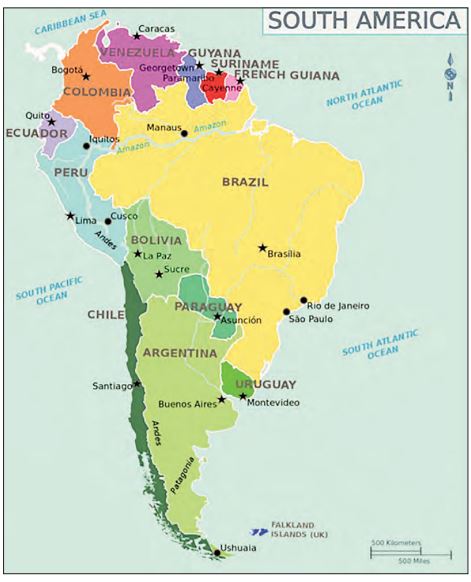
Map of South America
Here is a map of South America. Try to find the well-known countries — Brazil, Argentina, Chile, Peru, Colombia — and the long line of the Andes mountains running down the western coast.
Reading: South America — Mountains, Rainforest, and Music
South America is the fourth largest continent on Earth. It sits mostly in the Southern Hemisphere, with the Pacific Ocean to the west and the Atlantic Ocean to the east. Around 430 million people live in South America today.
The continent has twelve countries: Brazil, Argentina, Chile, Peru, Colombia, Venezuela, Ecuador, Bolivia, Paraguay, Uruguay, Guyana, and Suriname. There is also a small region in the north called French Guiana, which still belongs to France. Brazil is by far the largest country — it covers nearly half of the entire continent.
The geography of South America is amazing. The Andes, on the western side, are the longest mountain range above sea level in the world. They run all the way from Colombia in the north to the southern tip of Chile and Argentina. To the east, the giant Amazon Rainforest covers most of Brazil and parts of nine other countries. It is the largest rainforest on Earth, and home to more kinds of plants and animals than any other place — incredible biodiversity. Through the rainforest flows the Amazon River, the largest river in the world by water volume.
South America also has more extreme places. The Atacama Desert in northern Chile is often called “the driest place on Earth” — in some parts, almost no rain has ever been recorded. Far in the south, the wild region of Patagonia has cold winds, glaciers, and lonely landscapes. Off the coast of Ecuador are the famous Galápagos Islands, where Charles Darwin studied the animals that helped him develop his ideas about evolution.
Most people in South America speak Spanish — except in Brazil, where the language is Portuguese. In Guyana people speak English; in Suriname they speak Dutch. Many indigenous languages are also spoken, especially Quechua and Aymara in the Andes, and Guarani in Paraguay. These are the languages of the native peoples who lived on the continent long before Europeans arrived.
The history of South America is very old. The most famous ancient civilization was the Inca Empire, which ruled large parts of the Andes from the 1400s. The Inca built impressive cities of stone, including the world-famous Machu Picchu in Peru. Earlier civilizations, like the Moche and the Chimu, also built great cities and made beautiful art. Starting in the 1500s, Spain and Portugal colonized the continent. They brought their languages, their religion, and their laws — and also great suffering for the native peoples.
In the early 1800s, most South American countries fought for and won their independence from Spain and Portugal. Heroes like Simón Bolívar and José de San Martín are still remembered as the founders of modern South American nations.
The climate of South America is just as varied as its geography. Near the equator (Brazil, Colombia, Ecuador) it is warm and rainy all year. The Andes have cold mountain weather, with snow on the highest peaks. The far south is cold and windy. The middle of Argentina has four clear seasons — but they are the opposite of Europe and North America: when it is winter in Israel, it is summer there.
Today, South America is famous all over the world for its culture. Football (soccer) is a huge passion — Argentina and Brazil have produced some of the best players in history. Latin music — samba, tango, salsa, reggaeton — is loved everywhere. South American food, dance, and art are a strong part of global culture. The continent’s economies are still developing, but the future is full of possibilities.
Vocabulary
| Word | Meaning |
|---|---|
| continent | one of the seven very large areas of land on Earth |
| hemisphere | one of the two halves of the Earth (Northern or Southern) |
| geography | the study of the lands, mountains, rivers and people of a place |
| mountain range | a long line of mountains close together (e.g. the Andes) |
| rainforest | a thick forest in a warm, very rainy part of the world |
| river | a long line of fresh water that flows from high land to the sea |
| desert | a place that gets very little precipitation; can be hot or cold |
| glacier | a huge mass of ice that slowly moves over the land |
| island | a piece of land surrounded by water on all sides |
| biodiversity | the variety of different plants and animals living in a place |
| climate | the usual weather of a place over many years |
| tropical | describing the warm, often rainy areas near the equator |
| indigenous / native | the first people to live in a place, before others arrived from outside |
| civilization | a developed society with cities, writing and government |
| empire | a large territory ruled by one government, king or queen |
| colonize | to take political control of a country and send settlers there |
| independence | freedom — when a country rules itself, not another country |
| capital | the main city of a country, usually where the government is |
| language | the system of words and rules people use to speak and write |
| culture | the food, music, art, and way of life of a group of people |
| developing (country) | a country whose economy is still growing toward full industrial level |
| economy | the system of money, work and goods of a country or region |
| passion | a very strong feeling of love or interest for something (e.g. football) |
| waterfall | water that falls straight down from a high place (like Iguazu Falls) |
Practice — Reading Comprehension & Knowledge of South America
The questions mix reading comprehension (about the passage above) and general knowledge of South America (countries, capitals, landmarks, vocabulary). At the end you’ll see your score and can retest only the questions you missed.
After the Lesson — Personal Worksheet
Now think about everything you have read, watched, and seen in this unit. Use this worksheet to write your own answers in your own words. Your answers are saved automatically. When you’re done, you can print your worksheet.
