

Unit 10 — Planet Earth and the World
About this unit
In this unit we travel around the world without leaving our seats. You will watch a short video about our planet, read a passage about Earth and its continents, learn the key vocabulary, and complete an interactive practice with 30 questions about world geography.
Watch — A Tour of Our Planet
Watch this video carefully. You can replay it as many times as you need and turn on subtitles if it helps you. After you finish watching, answer the reflection questions in the worksheet at the bottom of this page.
Reading: Our Planet, Our World
Earth is the third planet from the Sun. As far as we know, it is the only planet where life exists. From space, our planet looks blue and white, because most of its surface is covered with water. For this reason, people sometimes call Earth “the blue planet.”
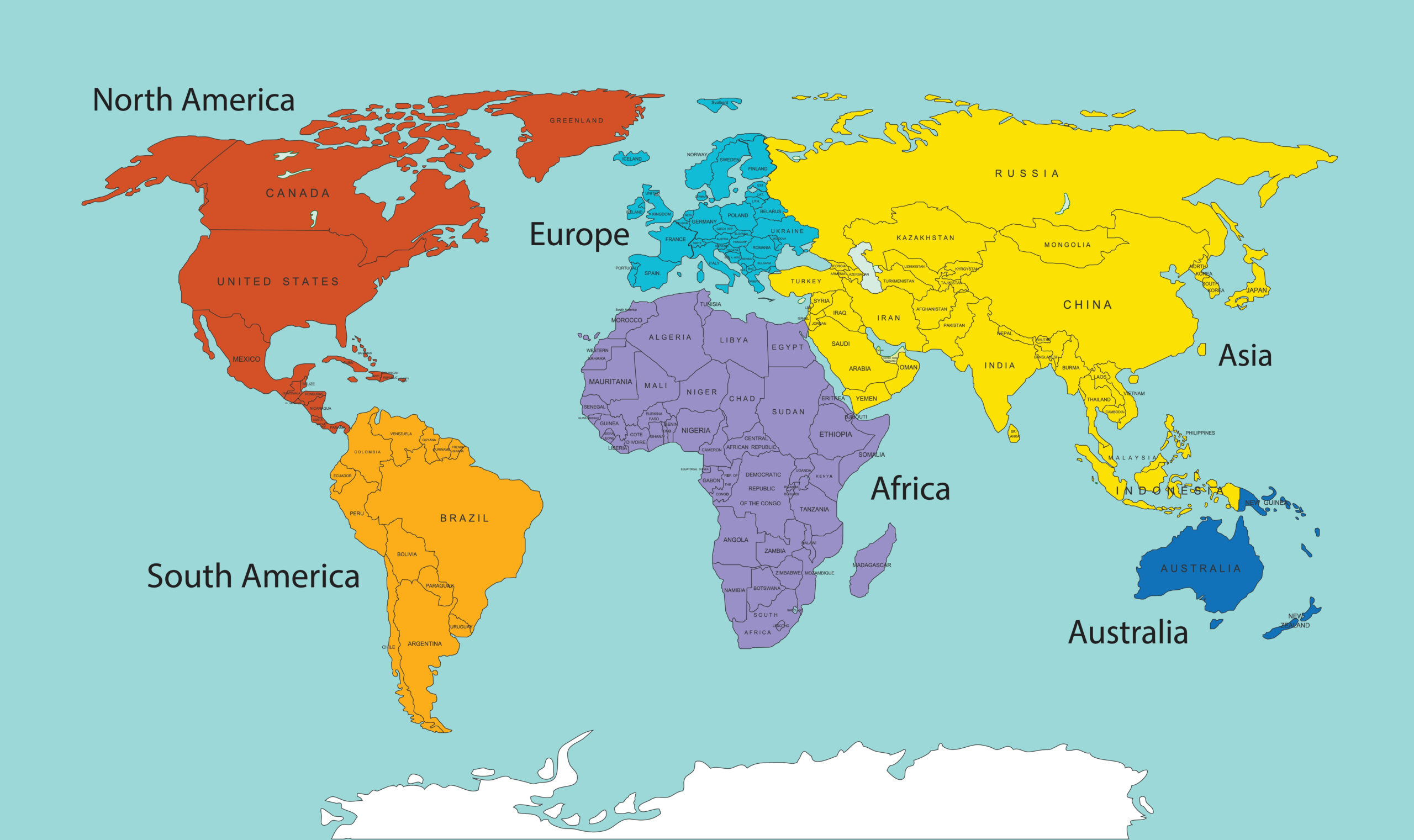
The land on Earth is divided into seven huge areas called continents: Africa, Antarctica, Asia, Australia, Europe, North America, and South America. Asia is the largest continent and the most crowded — more people live there than on any other continent. Australia is the smallest. Antarctica, in the far south, is covered with ice; very few people live there, mostly scientists in research stations.
Between the continents we find five oceans: the Pacific, the Atlantic, the Indian, the Southern, and the Arctic. Together, the oceans cover about 71% of the Earth’s surface. The Pacific Ocean is the largest — it is so big that all the continents in the world could fit inside it.
Earth has more than 190 countries. Each country has its own government, its own flag, and very often its own language. People around the world speak more than seven thousand different languages. The most common are English, Mandarin Chinese, Spanish, Hindi, Arabic, and many more. The line on a map between two countries is called a border, and the main city of each country — where the government usually sits — is called the capital.
To talk about location on Earth, we use special words. The line that goes around the middle of the planet is called the equator. The half above the equator is the Northern Hemisphere; the half below it is the Southern Hemisphere. We also use the four directions: north, south, east, and west.
Different parts of the world have very different climates. Near the equator, it is usually hot all year. Near the North and South Poles, it is very cold. In the areas in between, we have four seasons — spring, summer, autumn, and winter. The climate, the land, and the water together shape the environment in which plants, animals, and people live.
Even though we live in different countries and speak different languages, we all share one planet. Looking at a world map can help us see how big — and how connected — our world really is.
The Seven Continents
The World Map
Look at the map below. Find each of the seven continents and try to recognize the countries you have heard of. Use the colors to match what you read above.
Vocabulary
| Word | Meaning |
|---|---|
| planet | a very large round object that moves around a star |
| Earth | the planet we live on |
| surface | the outer or top part of something |
| continent | one of the seven very large areas of land on Earth |
| ocean | a very large area of salt water (Pacific, Atlantic, etc.) |
| sea | a smaller area of salt water, usually part of an ocean |
| country | an area of land with its own government and people (e.g. Israel, USA) |
| government | the group of people who run a country |
| flag | a piece of cloth with a special design that represents a country |
| language | the system of words and rules people use to speak and write |
| capital | the main city of a country, usually where the government is |
| border | the line on a map between two countries |
| population | the total number of people who live in a place |
| equator | the imaginary line around the middle of the Earth |
| hemisphere | one of the two halves of the Earth (Northern or Southern) |
| north / south / east / west | the four main directions on a map or compass |
| climate | the usual weather in a place over a long period of time |
| desert | a very dry area with little rain (e.g. the Sahara) |
| forest | a large area covered with trees (e.g. the Amazon) |
| mountain | a very high piece of land (much higher than a hill) |
| river | a long line of fresh water that flows from high land to the sea |
| map | a flat picture of an area of the Earth |
| globe | a round model of the Earth |
| environment | the natural surroundings (land, water, air, plants, animals) |
Practice — World Geography Quiz
Time to test what you know about our planet. The questions cover continents, oceans, countries, climate, and key geography vocabulary. At the end you’ll see your score and can retest only the questions you missed.
.sx-er{max-width:820px;margin:24px auto;font-family:’Segoe UI’,Arial,sans-serif;color:#0F172A!important} .sx-er .sx-card{background:#fff;border:1px solid #E2E8F0;border-radius:14px;padding:22px;box-shadow:0 4px 14px rgba(0,0,0,.04)} .sx-er .sx-progress{height:8px;background:#E2E8F0;border-radius:99px;overflow:hidden;margin-bottom:16px} .sx-er .sx-bar{height:100%;background:#1E40AF;width:0;transition:width .3s} .sx-er .sx-qnum{font-size:14px;color:#64748B;margin-bottom:4px} .sx-er .sx-qtext{font-size:18px;font-weight:700;margin-bottom:14px;line-height:1.5} .sx-er .sx-opts{display:grid;grid-template-columns:repeat(2,1fr);gap:10px} @media(max-width:520px){.sx-er .sx-opts{grid-template-columns:1fr}} .sx-er .sx-opt{padding:12px 16px;border:2px solid #E2E8F0!important;background:#F8FAFC!important;color:#0F172A!important;border-radius:10px;cursor:pointer;text-align:left;font-size:16px;font-weight:600;transition:all .15s;display:block;width:100%;font-family:inherit} .sx-er .sx-opt:hover{border-color:#3B82F6!important;background:#EFF6FF!important} .sx-er .sx-opt.correct{border-color:#16A34A!important;background:#DCFCE7!important;color:#14532D!important} .sx-er .sx-opt.wrong{border-color:#DC2626!important;background:#FEE2E2!important;color:#7F1D1D!important} .sx-er .sx-feedback{margin-top:10px;font-weight:600;font-size:15px;min-height:22px} .sx-er .sx-feedback.ok{color:#16A34A} .sx-er .sx-feedback.bad{color:#DC2626} .sx-er button.sx-btn{margin-top:14px;margin-right:6px;padding:12px 24px;background:#1E40AF;color:#fff!important;border:0;border-radius:8px;font-weight:700;cursor:pointer;font-size:15px} .sx-er button.sx-btn:hover{background:#3B82F6} .sx-er button.sx-btn.gray{background:#64748B} .sx-er button.sx-btn.red{background:#DC2626} .sx-er button.sx-btn.red:hover{background:#EF4444} .sx-er .sx-result{text-align:center;padding:18px 0} .sx-er .sx-score{font-size:48px;font-weight:900;color:#1E40AF} .sx-er .sx-pct{font-size:18px;color:#64748B;margin-bottom:14px} .sx-er .sx-wrongs{margin-top:16px;text-align:left} .sx-er .sx-wrongs h4{margin:0 0 8px;color:#DC2626} .sx-er .sx-wrongs ul{margin:0;padding-left:20px} .sx-er .sx-wrongs li{padding:6px 0}Questions to review (‘+wrong.length+’):
- ‘+
wrong.map(w=>’
- ‘+w.q+’
Correct: ‘+w.o[w.c]+’ ‘).join(”)+’
After the Video — Personal Worksheet
Now think about the video you watched at the top of this page. Use this worksheet to write your own answers in your own words. Your answers are saved automatically in your browser. When you’re done, you can print your worksheet.
.sx-w10{max-width:820px;margin:24px auto;font-family:’Segoe UI’,Arial,sans-serif;color:#0F172A!important} .sx-w10 .sx-block{background:#fff;border:1px solid #E2E8F0;border-radius:14px;padding:22px 26px;margin-bottom:20px;box-shadow:0 4px 14px rgba(0,0,0,.04)} .sx-w10 .sx-block h4{margin:0 0 6px;color:#1E40AF;font-size:18px} .sx-w10 textarea.sx-area{display:block;width:100%;border:2px solid #E2E8F0;border-radius:10px;padding:12px;font-size:15px;font-family:inherit;color:#0F172A;line-height:1.6;min-height:90px;resize:vertical;background:#F8FAFC;transition:border-color .15s} .sx-w10 textarea.sx-area:focus{outline:none;border-color:#1E40AF;background:#fff} .sx-w10 .sx-row{display:flex;flex-wrap:wrap;gap:10px;margin-top:10px} .sx-w10 button.sx-btn{padding:11px 22px;background:#1E40AF;color:#fff!important;border:0;border-radius:8px;font-weight:700;cursor:pointer;font-size:15px;font-family:inherit} .sx-w10 button.sx-btn:hover{background:#3B82F6} .sx-w10 button.sx-btn.gray{background:#64748B} .sx-w10 button.sx-btn.gray:hover{background:#94A3B8} .sx-w10 .sx-saved{display:none;margin-top:10px;padding:8px 12px;background:#DCFCE7;color:#14532D;border-radius:6px;font-size:14px;font-weight:600} .sx-w10 .sx-saved.show{display:inline-block} @media print{ .sx-w10 .sx-row{display:none} .sx-w10 textarea.sx-area{border-color:#94A3B8;background:#fff} }